Most first-time B2B buyers start with price, MOQ, and lead time. Those are good questions, but they're secondary. The first question should be: can I legally sell this product in my target market? If the answer is no, none of the other questions matter.
Three real costs of skipping regulatory planning:
KONGDY Health treats regulatory compliance as part of the order—not an afterthought. Every quote includes regulatory status by destination market.
Pain patches fall under different regulatory classifications depending on the market and the product's claims. For most OTC pain patches (capsaicin, menthol, lidocaine), the four largest frameworks are:
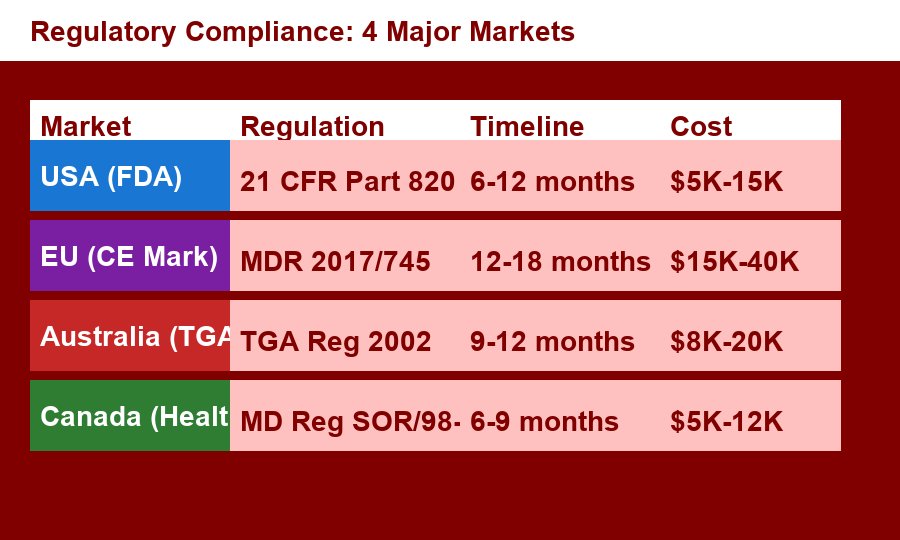
Each framework has its own classification logic, dossier requirements, and timeline. Here's the high-level comparison:
| Market | Regulation | Typical Timeline | Typical Cost |
|---|---|---|---|
| USA (FDA) | 21 CFR Part 820 | 6-12 months | $5K-15K |
| EU (CE Mark) | MDR 2017/745 | 12-18 months | $15K-40K |
| Australia (TGA) | TGA Reg 2002 | 9-12 months | $8K-20K |
| Canada (Health Canada) | MD Reg SOR/98-282 | 6-9 months | $5K-12K |
The US Food and Drug Administration (FDA) regulates pain patches as either medical devices (most OTC patches) or over-the-counter (OTC) drugs (some menthol/capsaicin patches). Most KONGDY products fall under the medical device category.
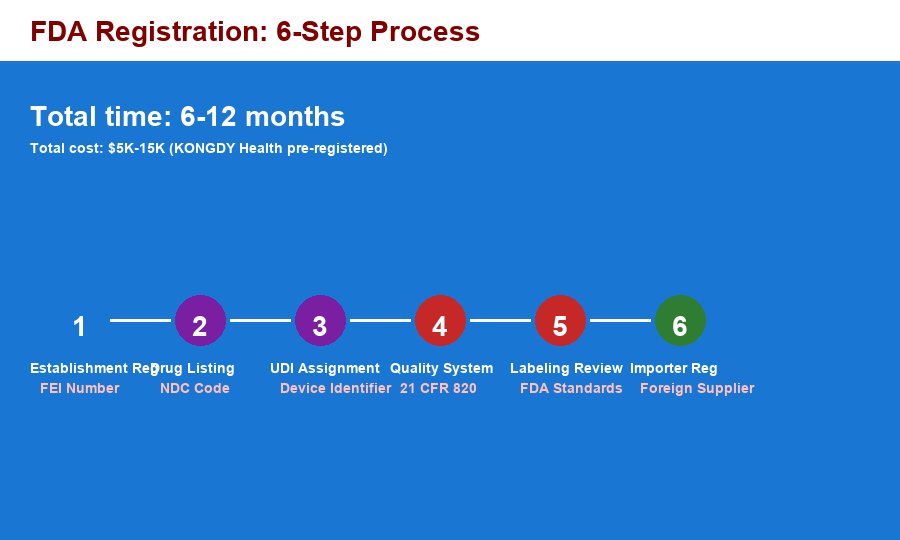
The foreign manufacturer (in this case, KONGDY Health) registers with the FDA and obtains a Facility Establishment Identifier (FEI) number. This is a one-time registration, valid until the facility closes or changes ownership.
Documents required:
Each product is listed with the FDA and assigned a National Drug Code (NDC). The NDC is a 10-digit identifier (labeler-product-package) used in the US for drug tracking.
Documents required:
For medical devices, the FDA requires a Unique Device Identifier (UDI) — a numeric or alphanumeric code that identifies the specific product and its packaging. The UDI is generated through an FDA-accredited issuing agency (e.g., GS1, ICCBBA).
Documents required:
For medical devices, the manufacturer must comply with 21 CFR Part 820 (Quality System Regulation). KONGDY Health is audited annually and maintains full compliance with: design controls, document controls, purchasing controls, identification and traceability, production and process controls, acceptance activities, nonconforming product controls, corrective and preventive actions, labeling and packaging controls, handling, storage, distribution, installation, records, servicing, and statistical techniques.
US label requirements are specific: principal display panel, information panel, ingredients, warnings, dosage, manufacturer info, lot/batch code, expiration date, storage conditions. KONGDY Health provides FDA-compliant label artwork for every US-bound shipment.
The US-based importer (the buyer) must register with the FDA and comply with the Foreign Supplier Verification Program (FSVP). This is the buyer's responsibility, not the seller's. KONGDY Health provides all required documentation to support the buyer's FSVP compliance.
Total FDA registration timeline: 6-12 months for first product. Subsequent products (using the same facility and same active ingredients) typically take 2-3 months.
The European Union's Medical Device Regulation (MDR 2017/745) replaced the previous MDD in May 2021. CE marking under MDR is more rigorous than MDD was, especially for Class IIa and above.
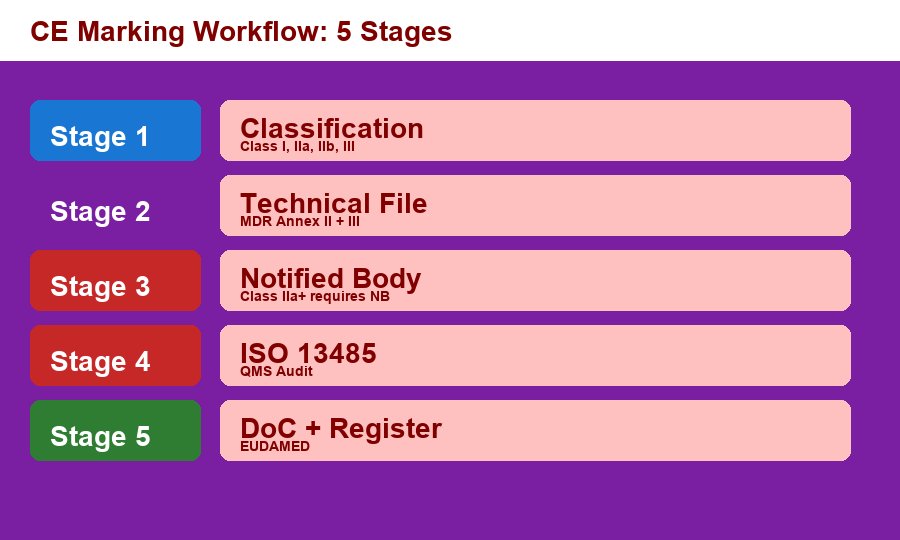
Pain patches are typically classified as:
Most KONGDY pain patches fall into Class I or IIa. The classification determines the regulatory pathway: Class I is self-declared; Class IIa+ requires Notified Body involvement.
The Technical File (per MDR Annex II and III) includes:
This file is the core of CE compliance and must be available for inspection by regulatory authorities and Notified Bodies.
For Class IIa devices, a Notified Body (e.g., TÜV SÜD, BSI, DEKRA) reviews the Technical File and audits the manufacturer's QMS. KONGDY Health works with TÜV SÜD as the primary Notified Body for EU MDR compliance.
The Notified Body issues an EU Technical Documentation Assessment Certificate after successful review.
Manufacturers must hold an ISO 13485 certificate from a Notified Body or accredited certification body. KONGDY Health has been ISO 13485 certified since 2014, with annual surveillance audits and recertification every 3 years.
The Declaration of Conformity (DoC) is the manufacturer's formal statement that the product meets all applicable EU regulations. The DoC is signed by the manufacturer's authorized representative and kept on file for 10 years.
EUDAMED is the European Database on Medical Devices. Class I devices must be registered; Class IIa+ devices require UDI assignment and EUDAMED registration before market placement.
Total CE marking timeline: 12-18 months for first product. Subsequent products (same classification, same Notified Body) typically take 3-6 months.
The Therapeutic Goods Administration (TGA) regulates pain patches in Australia. Most pain patches are listed as "complementary medicines" or "medical devices" depending on the claims.
For novel products or novel claims, a pre-meeting with TGA clarifies the regulatory pathway. KONGDY Health has had 4 pre-meetings with TGA since 2018.
The Australian Register of Therapeutic Goods (ARTG) is the public database of all therapeutic goods legally supplied in Australia. Pain patches must be included in the ARTG before market placement.
Application includes:
TGA audits the manufacturing facility, typically in conjunction with the Notified Body audit for ISO 13485. KONGDY Health has been audited by TGA twice (2019, 2023) with positive outcomes both times.
Once listed, the sponsor has ongoing post-market obligations: adverse event reporting, annual reporting, post-market surveillance, and label compliance.
Total TGA timeline: 9-12 months for first product. Subsequent products: 4-6 months.
Health Canada regulates pain patches as Medical Devices (Class I or II) under the Medical Device Regulations SOR/98-282. Most pain patches fall into Class II.
Pain patches are typically Class II if they have therapeutic claims (e.g., "relieves arthritis pain"). Class I if no therapeutic claims (e.g., "provides warming sensation").
For Class II devices, a Medical Device Licence (MDL) is required. The application includes:
Health Canada reviews the MDL application. For Class II devices, the review is administrative (validating completeness and classification) rather than scientific (which is reserved for Class III and IV). The review typically takes 2-4 months.
CMDCAS is the Canadian equivalent of ISO 13485. The manufacturer must hold a CMDCAS certificate from a Canadian Medical Devices Conformity Assessment Body. KONGDY Health is audited by TÜV SÜD for both ISO 13485 and CMDCAS, with combined audits reducing total cost and time.
Once the MDL is issued, the manufacturer can legally sell the product in Canada. Post-license obligations include: problem reporting (similar to FDA's MDR), annual reporting, and license amendments for any product changes.
Total Health Canada timeline: 6-9 months for first product. Subsequent products: 3-4 months.
Most first-time B2B buyers need a regulatory partner—an Authorized Representative (AR) or in-country registration specialist—to complete the registration. Five questions to ask:
KONGDY Health maintains preferred regulatory partner relationships in 18 markets. Buyers can request introductions when they place their first order.
Across 16 years and 60+ markets, here are the 7 most common compliance pitfalls we've seen—and how to avoid them:
Three structural investments that help buyers avoid the pitfalls:
Our 2025 compliance metrics: 99.5% registration approval rate (no rejections), 0 customs holds due to compliance issues, 0 product recalls across 60+ markets.
For a B2B buyer, working with a manufacturer that already has registrations in your target market saves 6-12 months and $5K-40K. The math is simple:
When evaluating pain patch manufacturers, ask: which markets are you currently registered in? Can you share your registration certificates? KONGDY Health shares both publicly—and we maintain active registrations in 18 markets to make this conversation shorter for every buyer.
Registration is the start, not the end. Post-market obligations vary by market but include:
KONGDY Health's regulatory team handles all post-market obligations for the manufacturer's side; the buyer's regulatory partner handles the buyer's side (typically the importer of record).
Regulatory compliance isn't a cost center—it's a strategic asset. A buyer with active registrations in multiple markets can launch new products faster, enter new geographies without delay, and command better pricing from retailers who require compliant suppliers.
When evaluating pain patch manufacturers, compliance capability is a top-three criterion (along with production capacity and quality systems). KONGDY Health maintains active registrations in 18 markets, 4 major regulatory frameworks, and a 16-year compliance track record. We share our registration certificates on request—and our compliance team works directly with your regulatory partner to ensure smooth market entry.
Plan your next market entry with compliance at the center. Request a KONGDY registration pack including our current market coverage, dossier summaries, and regulatory partner introductions.