Complete customs clearance guide for pain patch imports. HS codes, import duties, required documentation, clearance timelines, and common pitfalls for 60+ countries. Used by B2B importers, OEM distributors, and trade compliance teams.
Why Customs Clearance Matters More Than You Think
Most B2B buyers focus on production quality, payment terms, and shipping mode. Customs clearance is the afterthought. That's exactly when it costs the most.
Three real consequences of customs missteps:
- Per-day detention fees: Most ports charge $50-200 per day per container after a free storage window (typically 7-14 days).
- Demurrage and per-diem charges: When the freight forwarder's container is stuck at port, the per-diem charges (often $100-300 per day) get passed to the buyer.
- Returned shipment: If the customs authority determines the goods are misdeclared or restricted, they may order re-export. The buyer pays return shipping + the original shipping cost.
A 2-week customs hold at the EU port can add $2,000-4,000 to a 50K-patch order's landed cost. KONGDY Health treats customs documentation as part of the production process, not an afterthought.
The HS Code: 3004.90 for Pain Patches
The Harmonized System (HS) code is the universal classification for international trade. For pain patches—whether OTC or pharmaceutical-grade transdermal—the standard HS code is 3004.90 ("Medicaments, packaged for retail sale, n.e.c."). The same code applies in nearly every jurisdiction, with minor national variations.
Some countries use extended codes (8-10 digits) for national-level classification:
- US (HTSUS): 3004.90.9215 (medicaments, n.e.c., in measured doses, for retail sale)
- EU (Combined Nomenclature): 3004 90 00
- China (Customs): 3004.90.00 (used for export declaration)
The wrong HS code is the #1 reason for customs holds. Common misclassifications we see:
- HS 3005 (wadding, gauze, bandages) — used for simple wound dressings, not pain patches with active ingredients
- HS 3824 (chemical preparations) — sometimes used for raw materials, not finished products
- HS 3824.99 (other chemical products) — sometimes misapplied to finished patches with no pharmacological claim
KONGDY Health always declares pain patches under HS 3004.90 with the proper product description. Buyers should verify their import agent uses the same code.
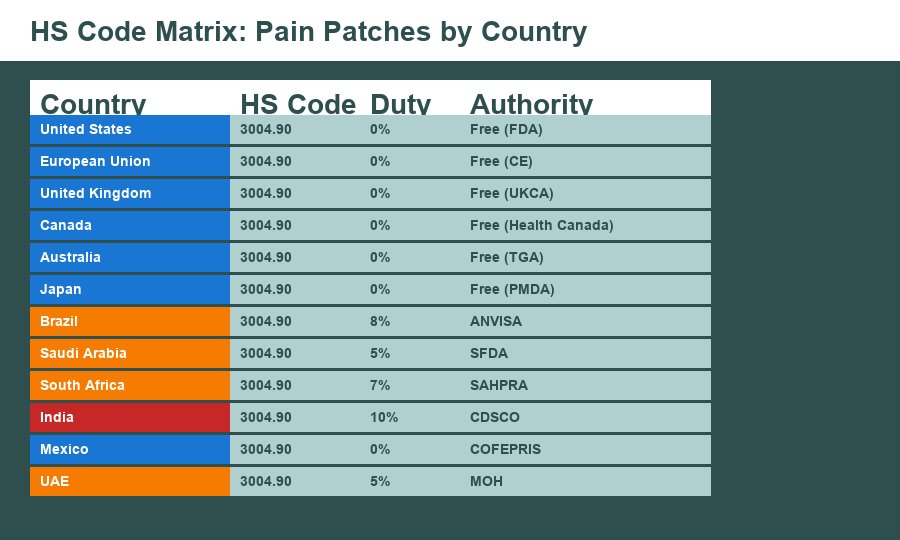
HS Code Matrix: 12 Major Markets
Here's a quick reference table for the most common destinations:
Free import (0% duty): US, EU, UK, Canada, Australia, Japan, Mexico, New Zealand, Singapore, Hong Kong, UAE, Saudi Arabia (most pain patches)
Low-duty (5-10%): Brazil (8%), South Africa (7%), India (10%), Russia (5-7%), Turkey (4-6%)
Variable (case-by-case): China (0% import duty for re-export), Korea (0-8%), Vietnam (0-5%), Thailand (1-5%)
The duty structure depends on:
- Active ingredients: Pharmaceutical-grade patches with menthol/capsaicin typically qualify for the 0% medicament duty band; cosmetic-grade patches may be classified differently.
- Origin country: China-origin products enjoy free trade agreement (FTA) benefits in many markets (e.g., China-Chile FTA, China-ASEAN FTA, China-Australia FTA).
- Product claims: "Pain relief" claims qualify for medicament classification; "warming comfort" claims may shift to a different code.
The 7-Step Customs Clearance Process
For a typical sea freight shipment from China to an overseas port, customs clearance follows a 7-step sequence. Each step has clear ownership and timing.
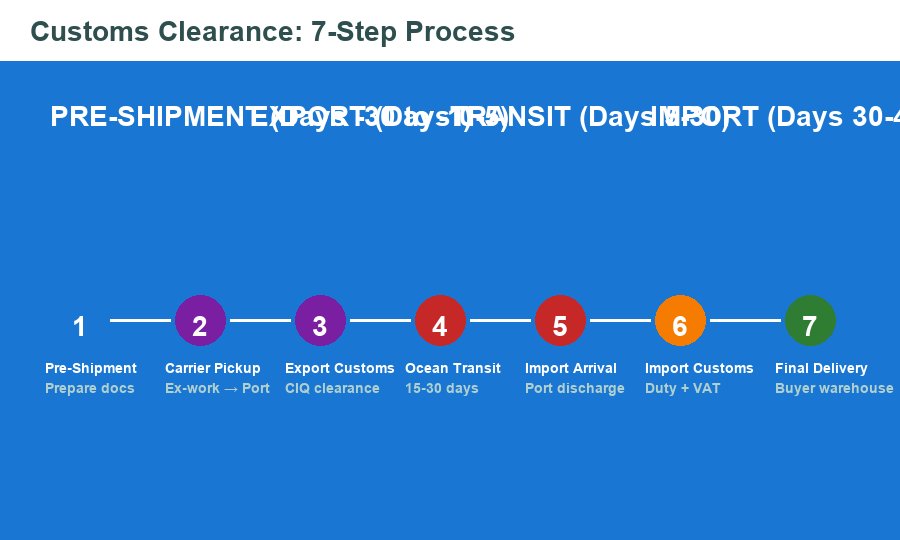
Step 1: Pre-Shipment Documentation (Days -30 to -1)
The seller prepares all required documents: commercial invoice, packing list, CoA, COO, MSDS, and any import permits. KONGDY Health's standard pre-shipment package includes 8 documents and arrives 5 days before vessel departure.
Step 2: Carrier Pickup (Day -2 to 0)
The buyer's nominated forwarder picks up the goods from KONGDY's bonded warehouse in Shenzhen or Guangzhou. The carrier issues a Master BOL (MBL) for FCL shipments or an MBL + House BOL (HBL) for LCL consolidated shipments.
Step 3: Export Customs Clearance (Days 0-3)
China's customs authority (海关总署 / GACC) inspects the export declaration. For pain patches, this typically takes 1-2 days for routine inspections and 3-5 days for first-time exporters or HS code spot checks. CIQ (China Inspection and Quarantine) clearance is also required for medical device exports.
Step 4: Ocean Transit (Days 5-30)
Vessel transit depends on destination: 12-15 days to most Asian ports, 18-25 days to European ports, 15-20 days to US West Coast, 25-30 days to US East Coast. Air freight is faster (5-7 days) but 4-5x more expensive.
Step 5: Import Arrival & Discharge (Day 30-32)
At the destination port, the goods are discharged from the vessel, scanned by customs (X-ray or physical inspection if flagged), and moved to a bonded warehouse. The buyer or their broker is notified within 24-48 hours.
Step 6: Import Customs Clearance (Days 32-35)
The buyer's import broker files the import declaration with destination customs, pays any duties and VAT, and arranges for release. For most pain patch imports into developed markets, this takes 1-3 business days; for first-time importers or specific regulated markets (Brazil, Saudi Arabia), 5-10 business days is normal.
Step 7: Final Delivery (Days 35-37)
Once released, the goods are delivered to the buyer's warehouse via drayage, trucking, or rail. The buyer signs a Proof of Delivery (POD), and the transaction is complete.
The 8 Required Customs Documents
Every pain patch shipment needs 8 standard documents. Missing any one can trigger a customs hold. KONGDY Health provides 7 of these in the standard pre-shipment package; the buyer typically handles the 8th (import permits).
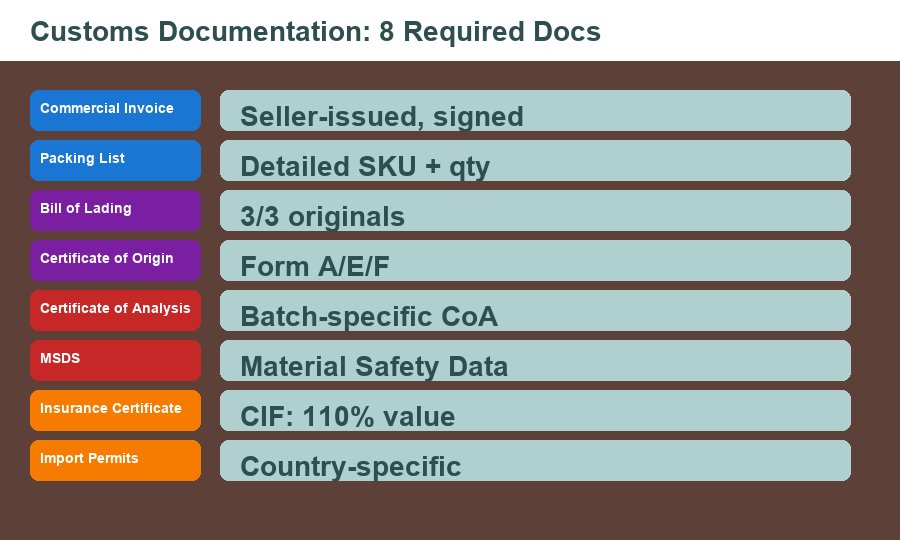
- Commercial Invoice: Seller-issued, signed, with HS code, country of origin, unit value, and total value.
- Packing List: Detailed SKU breakdown, quantity per SKU, carton count, weight, dimensions.
- Bill of Lading (BOL): 3/3 originals for ocean freight, Air Waybill (AWB) for air freight. Negotiable instrument that allows taking delivery.
- Certificate of Origin (COO): Issued by China Chamber of Commerce or CIQ. Form A, E, or F depending on the destination's trade agreement with China.
- Certificate of Analysis (CoA): Batch-specific, with assay results, microbial testing, and active-ingredient percentages.
- MSDS (Material Safety Data Sheet): 16-section document covering physical, chemical, and toxicological properties. Required for most regulated markets.
- Insurance Certificate: Required for CIF terms, 110% of CIF value. Buyer's own policy reference is fine for FOB terms.
- Import Permits / Registrations: Country-specific. FDA Establishment Registration for US, CE Technical File for EU, TGA Certificate for Australia, etc.
For private label or OEM products, additional documents may be required: trademark license, brand authorization letter, and label artwork (showing the destination market's specific label requirements).
How Duties & VAT Work: The Total Landed Cost
The customs process has three cost components: import duty, value-added tax (VAT), and miscellaneous port fees.
Import Duty
The base customs duty, calculated on the CIF value (Cost + Insurance + Freight). For most pain patch imports, this is 0% under HS 3004.90. For markets where it's not, expect 4-10%.
VAT / GST
Calculated on (CIF value + duty). VAT rates vary by market:
- EU: 0-27% depending on member state (Germany 19%, France 20%, Italy 22%)
- UK: 20%
- US: Sales tax varies by state, 0-10%
- Australia: 10% GST
- Canada: 5% GST + provincial sales tax (5-15%)
- UAE: 5% VAT
- Saudi Arabia: 15% VAT
For a $50K order landing in Germany with 0% duty + 19% VAT, the buyer pays $9,500 VAT upfront, recoverable as input VAT credit (for VAT-registered businesses).
Miscellaneous Port Fees
THC (Terminal Handling Charge), ISF (Importer Security Filing for US), DDP fee, customs broker fee. Typical total: $300-1,000 per container.
Country-Specific Customs Notes: Top 8 Markets
Each major market has unique quirks. Here's the playbook for the 8 most common pain patch destinations:
United States (FDA)
- HS Code: 3004.90 (0% duty)
- Required registrations: FDA Establishment Registration (FEI), Drug Listing, UDI
- Special docs: Prior Notice (for consumable products), ISF 10+2 filing
- Typical clearance time: 3-5 business days
- Key risk: FDA holds for misbranding or label non-compliance. KONGDY Health pre-validates all US-bound labels.
European Union (CE)
- HS Code: 3004 90 00 (0% duty)
- Required registrations: CE Technical File, EUDAMED registration, EU MDR compliance
- Special docs: Declaration of Conformity, Notified Body certificate (for Class IIa+)
- Typical clearance time: 1-3 business days
- Key risk: Member state-specific label translation requirements (24 official EU languages). KONGDY Health provides translation services for the 10 most common.
United Kingdom (UKCA)
- HS Code: 3004.90 (0% duty)
- Required registrations: UKCA marking (post-Brexit), MHRA registration
- Special docs: UK Declaration of Conformity (separate from EU DoC)
- Typical clearance time: 1-2 business days
- Key risk: Some products still require UKCA + CE dual marking until 2030.
Canada (Health Canada)
- HS Code: 3004.90 (0% duty)
- Required registrations: Health Canada MDL (Medical Device Licence) for Class II+, NHP for natural health products
- Special docs: Bilingual labeling (English + French) mandatory
- Typical clearance time: 2-4 business days
- Key risk: Bilingual labeling errors are the #1 hold reason. KONGDY Health provides French translation and verification.
Australia (TGA)
- HS Code: 3004.90 (0% duty)
- Required registrations: TGA ARTG inclusion (Australian Register of Therapeutic Goods)
- Special docs: TGA certificate, sponsor appointment letter
- Typical clearance time: 3-5 business days
- Key risk: TGA audits are rigorous; ARTG inclusion is mandatory for medical claims.
Brazil (ANVISA)
- HS Code: 3004.90 (8% duty)
- Required registrations: ANVISA registration (12-18 month process), Brazilian Portuguese labeling
- Special docs: ANVISA import license, Portuguese label artwork, INMETRO certification for some categories
- Typical clearance time: 7-15 business days
- Key risk: ANVISA's 8% duty + ICMS state tax (17-20%) + PIS/COFINS (9.25%) brings total import cost to ~35-40% of CIF value.
Saudi Arabia (SFDA)
- HS Code: 3004.90 (5% duty)
- Required registrations: SFDA medical device authorization, Saudi Authorized Representative (AR)
- Special docs: Arabic labeling (mandatory), SFDA certificate, SASO conformity certificate
- Typical clearance time: 5-10 business days
- Key risk: Arabic label errors are a major hold reason. KONGDY Health provides Arabic translation and SFDA-specific artwork.
South Africa (SAHPRA)
- HS Code: 3004.90 (7% duty)
- Required registrations: SAHPRA medical device registration, South African Authorized Representative
- Special docs: SAHPRA certificate, English + Afrikaans labeling (one official language, recommended both)
- Typical clearance time: 5-10 business days
- Key risk: Port of Durban congestion can add 5-7 days to clearance. Plan accordingly.
How to Choose the Right Import Broker
A good import broker is worth 5x the cost of a bad one. Five questions to ask when choosing:
- How many pain patch imports have you cleared in the past 12 months? A broker with 20+ pain patch clearances knows the common pitfalls. A generalist will learn on your shipment.
- What's your first-time clearance success rate? Top brokers hit 95%+ on first submission. Lower rates mean rework, delays, and extra fees.
- Can you handle [specific market]'s registration requirements? Markets like Brazil, Saudi Arabia, and India require in-country registration that a US- or EU-based broker can't do alone.
- What's your typical response time for customs queries? A 24-hour response is standard; a 4-hour response is premium. Anything slower risks per-day detention fees.
- Do you offer landed-cost calculation upfront? The best brokers provide a complete cost breakdown (duty + VAT + fees) before the goods ship, so you can decide on shipping mode vs. cost.
KONGDY Health maintains a vetted list of 28 import brokers across our 60+ destination countries. Buyers can request the list when they place their first order.
How KONGDY Health Supports Your Customs Process
Three structural investments that reduce customs risk for our buyers:
- Pre-validated documentation: Every KONGDY pre-shipment package is reviewed by a senior export documentation specialist. The same 8 documents are produced for every shipment, with the same formatting.
- Country-specific label artwork: KONGDY maintains label artwork libraries for 32 countries, including all mandatory translations, ingredient declarations, and warning statements.
- In-country registration partnerships: KONGDY has Authorized Representative agreements in 18 markets (EU, UK, Australia, Brazil, Saudi Arabia, etc.), so buyers don't have to find their own local partner.
Our 2025 customs metrics: 99.2% first-attempt clearance rate, 2.1-day average import clearance time across 60+ markets, 0 customs-related shipment returns.
How to Handle a Customs Hold
Even with perfect documentation, occasional holds happen. Here's the playbook:
- Day 0: Receive customs query notification. Read the specific issue (usually documentation or label-related).
- Day 1: Engage the buyer's import broker. Confirm whether the issue is fixable via document submission or requires re-export.
- Day 2-3: Submit supplementary documents. For label issues, the seller (KONGDY) provides corrected labels within 48 hours.
- Day 4-7: Customs reviews and releases. If rejected, the broker files an appeal or arranges re-export.
The most common hold reasons and resolutions:
- HS code mismatch: Resolved with supplementary documentation from seller; typically 1-2 day hold.
- Label language/translation error: Resolved with corrected label; typically 2-4 day hold.
- Missing import permit: Cannot resolve at port; buyer must register in destination market. 5-15 day hold typical.
- Product classification dispute: Resolved with technical documentation; 3-7 day hold.
For holds exceeding 14 days, KONGDY Health offers replacement goods at preferential terms to keep the buyer's supply chain moving.
Final Thoughts: Customs as Part of the Production Timeline
The biggest mistake in international B2B trade is treating customs clearance as an afterthought. Customs is part of the production timeline—starting with the seller's first pre-shipment document, ending with the buyer's POD signature. The 30-day order-fulfillment cycle becomes a 60-day cycle if customs isn't planned for.
When evaluating pain patch manufacturers, ask for: their customs success rate by market, their Authorized Representative partnerships, and their pre-validated documentation libraries. KONGDY Health shares all three publicly—and we've shipped to 60+ countries without a single customs-related return.
Plan your next ordering cycle with customs included. Request a KONGDY import playbook for your destination market today.