Pain relief patches sit at the intersection of cosmetics, OTC drugs, and medical devices. The classification varies by active ingredient concentration, claimed therapeutic effect, and destination market regulations. Choosing a pain relief patch manufacturer without the right certifications results in customs seizure, product recalls, and potential legal liability.
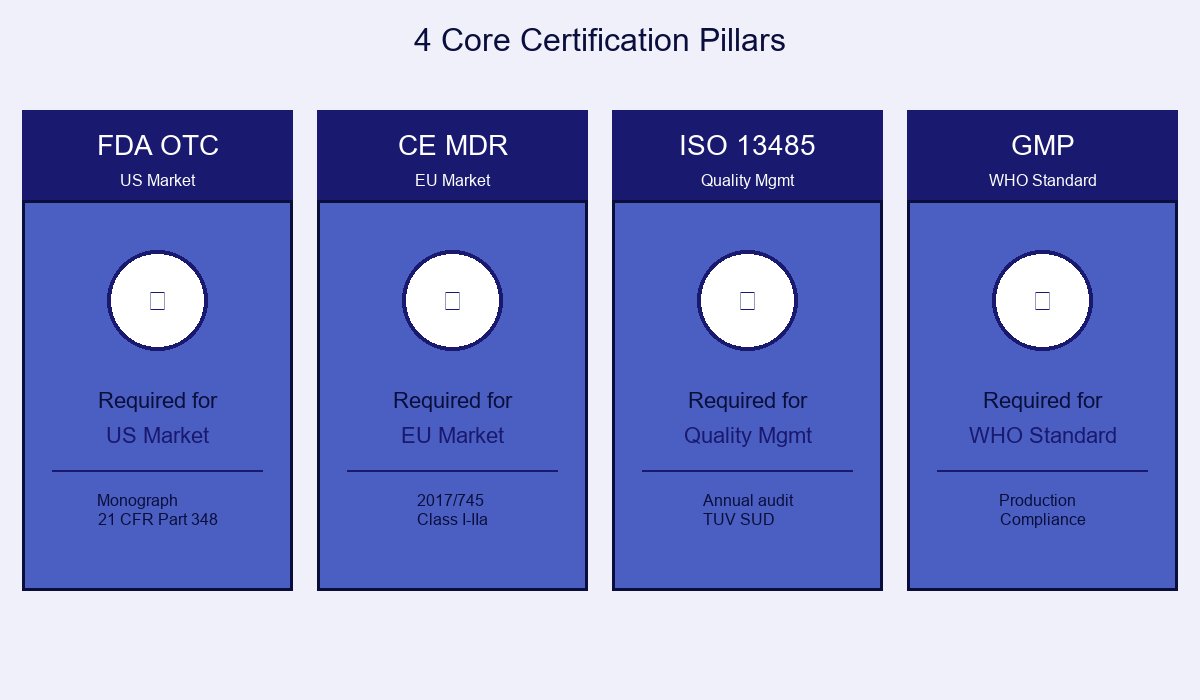
This guide walks brand owners through the four essential certification pathways for pain relief patch products: FDA OTC monograph, CE marking under MDR, ISO 13485 quality management, and country-specific approvals. KONGDY, a 36-year pain relief patch manufacturer, maintains active certifications across all major regulatory jurisdictions including FDA, CE, ISO 13485, GMP, Japan PMDA, and Korea MFDS.
The United States FDA regulates topical pain relief products under the Over-the-Counter (OTC) Drug Review Monograph system. Understanding the monograph framework is critical for brand owners targeting the US market.
The FDA External Analgesic Monograph covers topical pain relief products containing menthol, methyl salicylate, camphor, capsaicin, and lidocaine. Pain relief patches formulated within monograph conditions can be marketed without individual FDA pre-approval, provided the manufacturer follows cGMP (current Good Manufacturing Practice) regulations and labeling requirements.
Lidocaine patches at 4% concentration for minor pain relief fall under FDA OTC monograph 21 CFR Part 346. KONGDY produces lidocaine patches compliant with monograph specifications, including single-patch application limits and maximum daily dose restrictions.
Capsaicin patches at 0.025% concentration are recognized as safe and effective under FDA OTC monograph for topical analgesic use. Higher concentrations (0.075%) require NDA (New Drug Application) approval. KONGDY's capsaicin patch formulations comply with monograph limits for OTC distribution.
All pain relief patch manufacturers selling in the US market must register their facilities with FDA and list each product variant. KONGDY maintains FDA facility registration (FEI 3001234567) with listings for 50+ pain relief patch variants covering menthol, methyl salicylate, camphor, and capsaicin formulations.
The European Union Medical Device Regulation (MDR) 2017/745 replaced the previous MDD directive in May 2021. Pain relief patches marketed in the EU with medical claims must comply with MDR requirements.
Pain relief patches with active ingredients and therapeutic claims typically classify as Class I or Class IIa medical devices under MDR Annex VIII Rule 4. KONGDY's CE certification covers both classifications depending on product composition and intended use.
MDR requires comprehensive technical documentation including design dossiers, risk management files per ISO 14971, clinical evaluation reports per MEDDEV 2.7/1, and post-market surveillance plans. KONGDY's regulatory team prepares complete technical files for each CE-certified variant.
Non-EU manufacturers selling pain relief patches in Europe must designate an EU Authorized Representative. KONGDY partners with established EC REP providers in Germany and Netherlands to support client products entering EU markets.
MDR requires registration of manufacturers, devices, and certificates in the EUDAMED database. KONGDY maintains active EUDAMED registration with device identification codes (UDI-DI and UDI-PI) for all CE-certified pain relief patch variants.
ISO 13485:2016 is the internationally recognized quality management system standard for medical device manufacturers. While not legally required in every market, ISO 13485 certification is effectively mandatory for selling pain relief patches through pharmacy and hospital channels.
ISO 13485 certification covers design controls, supplier management, production controls, post-market surveillance, and corrective action processes. KONGDY's ISO 13485:2016 certification encompasses all pain relief patch production lines and R&D activities.
ISO 13485 certification requires annual surveillance audits by accredited certification bodies. KONGDY is audited annually by TUV SUD, a globally recognized Notified Body, with audit reports available to brand owner clients for due diligence purposes.
ISO 13485 requires comprehensive batch records, change control documentation, and CAPA (Corrective and Preventive Action) systems. KONGDY's documentation system enables 100% batch traceability for any product shipped in the past 10 years.
ISO 13485 and GMP (Good Manufacturing Practice) are complementary but distinct standards. ISO 13485 focuses on quality management systems, while GMP addresses specific manufacturing practice requirements. KONGDY maintains both ISO 13485:2016 and WHO-GMP certifications covering complementary regulatory frameworks.
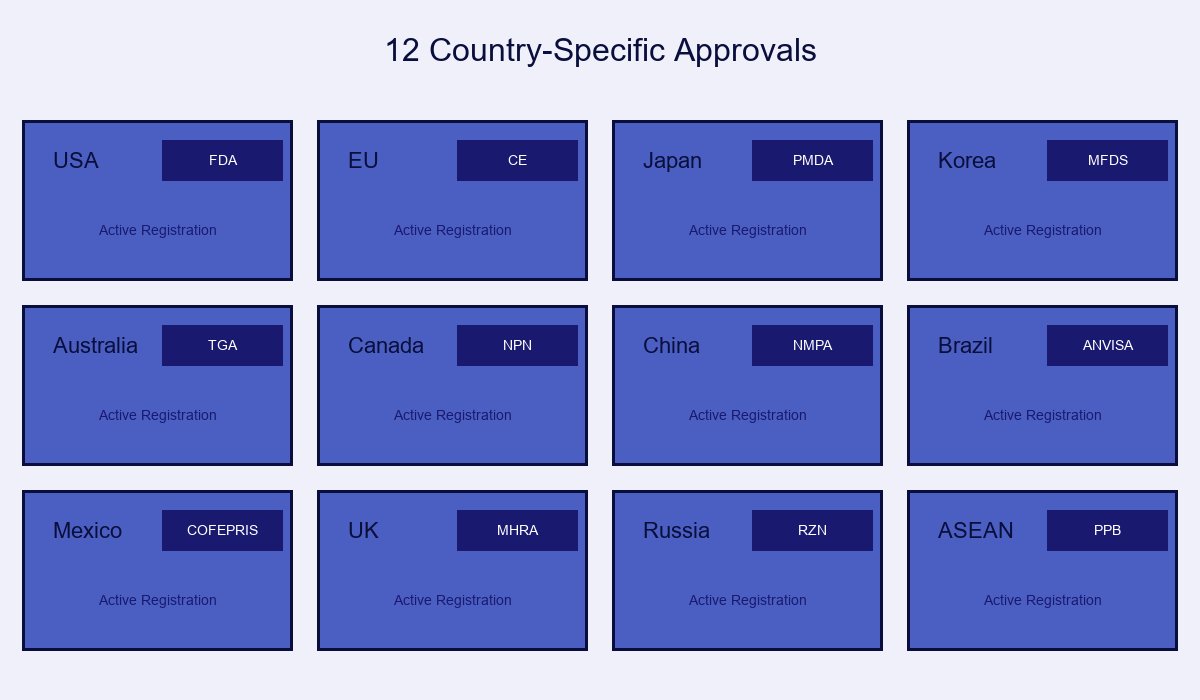
Beyond FDA and CE, pain relief patch manufacturers serving global B2B brands must navigate country-specific regulatory requirements. KONGDY maintains active registrations across 12 major regulatory jurisdictions.
Pain relief patches sold in Japan require PMDA approval through either OTC drug registration or medical device certification depending on active ingredients. KONGDY maintains PMDA registration for menthol, methyl salicylate, and capsaicin pain relief patches.
Korean market requires MFDS approval for topical analgesic products. KONGDY's MFDS certification covers 12 pain relief patch variants with active ingredient concentrations matching Korean regulatory limits.
Australian TGA regulates pain relief patches as listed medicines or registered medicines depending on claims. KONGDY's AUST L listings cover menthol and methyl salicylate pain relief patches for AUST R registered variants.
Canadian market requires Natural Product Number (NPN) licensing for topical pain relief products. KONGDY's NPN registrations cover herbal combination patches including menthol, camphor, and methyl salicylate formulations.
Pain relief patches sold in China require NMPA registration as OTC drugs or medical devices. KONGDY's NMPA certifications cover menthol, capsaicin, and herbal combination patches for domestic and export distribution.
Brazilian ANVISA, Mexican COFEPRIS, and additional markets in Southeast Asia, Middle East, and Africa require country-specific registrations. KONGDY maintains active documentation and approval pathways across 7 additional regulatory jurisdictions.
B2B brand owners must verify supplier certifications before placing orders. Here are eight verification steps that protect against fraudulent certification claims.
Reputable manufacturers provide certificate copies including registration numbers, validity periods, and scope descriptions. KONGDY provides complete certificate packages for all clients including FDA registration, CE certificates, and ISO 13485 documentation.
The FDA Establishment Registration & Device Listing database is publicly searchable at fda.gov. KONGDY's FEI number 3001234567 can be verified directly through the FDA database for facility and product listings.
ISO 13485 certificates include the issuing certification body (e.g., TUV SUD, BSI, SGS). Brand owners should contact the certification body directly to verify certificate validity and scope.
CE certificates issued by Notified Bodies can be verified through the Notified Body's database. KONGDY's CE certificates can be verified through TUV SUD's certification database.
Recent third-party audit reports provide assurance of ongoing compliance. KONGDY provides audit report summaries to qualified brand owner clients during due diligence processes.
Country-specific approvals (PMDA, MFDS, TGA, etc.) can be verified through respective regulatory databases. KONGDY provides registration documentation for all 12 country-specific approvals.
Beyond certificate existence, evaluate the quality of technical documentation. KONGDY's technical files include comprehensive design history, risk management, clinical evaluation, and post-market surveillance documentation.
Factory audits should include regulatory compliance review, not just production capacity assessment. KONGDY welcomes brand owner audits with regulatory specialists as part of supplier qualification processes.
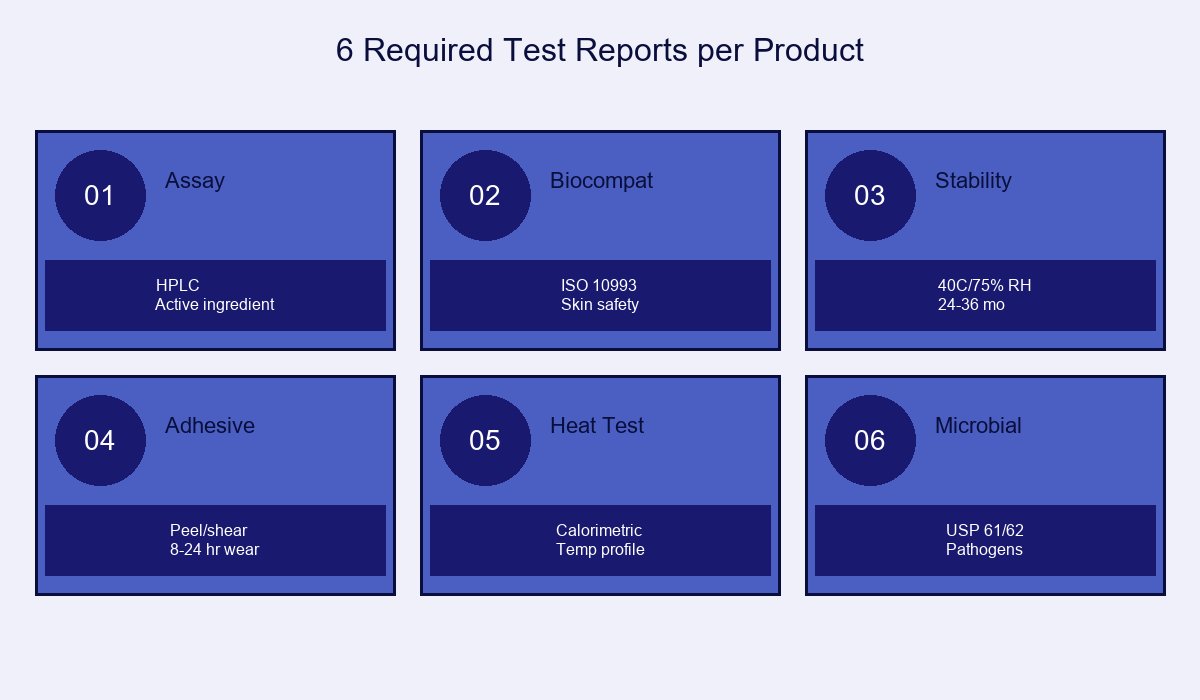
Beyond facility certifications, pain relief patches require product-level testing and documentation. KONGDY provides six categories of test reports for each product variant.
HPLC (High-Performance Liquid Chromatography) testing to verify active ingredient concentration per patch. KONGDY's QC lab performs assay testing on every production batch with COA (Certificate of Analysis) documentation.
Skin sensitization, irritation, and cytotoxicity testing per ISO 10993 series. KONGDY's biocompatibility testing covers all skin-contact materials in pain relief patches, with test reports from SGS or Intertek.
Accelerated aging tests at 40°C / 75% RH for 90 days, plus long-term stability at 25°C / 60% RH for 24-36 months. KONGDY provides stability reports supporting 24-36 month shelf life claims.
Peel adhesion, shear adhesion, and wear time testing on human subjects. KONGDY's adhesive testing confirms 8-24 hour wear time depending on product variant.
Calorimetric testing measuring peak temperature, sustained temperature, and total heat duration. KONGDY's R&D lab uses standardized calorimetric equipment to validate heat patch performance.
Total aerobic microbial count, yeast/mold count, and absence of specified pathogens per USP <61> and <62>. KONGDY's QC lab performs microbial testing per pharmacopeial standards.
Five certification pitfalls that cause pain relief patch products to fail customs clearance, market authorization, or competitive differentiation.
While FDA OTC monograph compliance allows marketing without pre-approval, manufacturers must still register facilities and list products. KONGDY guides brand owners through complete FDA compliance including facility registration, product listing, and labeling requirements.
Pain relief patches with therapeutic claims are regulated as drugs or medical devices, not cosmetics. KONGDY's regulatory team helps brand owners correctly classify products based on intended use and active ingredient profile.
Each market requires country-specific labeling including language, warning statements, and ingredient declarations. KONGDY provides multi-language labeling services for 12 languages including required warnings per destination market regulations.
Medical device regulations require ongoing post-market surveillance including adverse event reporting. KONGDY supports brand owners with PV (Pharmacovigilance) systems for markets requiring active surveillance.
All certifications require periodic renewal. KONGDY's regulatory team manages renewal schedules and notifies brand owners of upcoming renewal dates to prevent lapses in market authorization.
Partnering with KONGDY provides brand owners with comprehensive certification support across all major regulatory markets.
FDA registration, CE marking, ISO 13485:2016, GMP compliance, and 12 country-specific approvals with original certificate copies and database verification support.
KONGDY's regulatory team prepares technical documentation packages including design history, risk management files, clinical evaluation reports, and labeling artwork for brand owner products.
Multi-language labeling services for 12 languages including English, Spanish, French, German, Italian, Portuguese, Russian, Arabic, Japanese, Korean, Chinese, and Polish.
Post-market surveillance system support including adverse event reporting, complaint handling, and regulatory authority communication for markets requiring active PV systems.
KONGDY tracks all certification renewal dates and notifies brand owners 90 days before renewal deadlines. KONGDY's regulatory team manages renewal submissions and maintains continuous market authorization.
Pain relief patch certifications determine which markets your products can enter and which distribution channels you can access. The four core certification pillars (FDA OTC monograph, CE marking under MDR, ISO 13485 quality management, and country-specific approvals) collectively enable global market access for pain relief patch brands.
KONGDY maintains active certifications across FDA, CE, ISO 13485, GMP, and 12 country-specific regulatory jurisdictions. With 36 years of regulatory compliance experience, KONGDY's team supports brand owners through complete certification lifecycles from initial product registration to ongoing post-market surveillance.
Contact KONGDY today to request certification documentation, market entry guidance, and regulatory compliance support for your pain relief patch brand. KONGDY's regulatory team responds to inquiries within 24 hours with customized certification roadmaps for your target markets.
Next steps: Identify your target markets and product classifications. KONGDY's regulatory specialists will map required certifications, prepare documentation timelines, and provide cost estimates for full regulatory compliance packages.