Pain patch factory audit checklist for B2B buyers: 6 audit areas (25+20+18+15+12+10 pts), 100-point scoring system, 5 red flags to walk away (no ISO 13485, refuses audit, no CoA, fake OEM, no FDA), and step-by-step audit process. KONGDY Health scores 92/100 average, 200+ audits/year.
Pain Patch Factory Audit: The Complete B2B Buyer's Verification Checklist
A pain patch factory audit is the most important due diligence step before committing to a Chinese manufacturer. Industry data shows that 40% of first-time buyers report quality issues within the first six months of production, and 65% of those issues could have been caught with a thorough pre-production audit. The cost of a failed batch ranges from $20,000 to $500,000+ in lost product, recalls, and brand damage.
This comprehensive checklist, built from KONGDY Health's 15+ years of hosting 200+ factory audits annually, gives you the exact 100-point framework experienced B2B buyers use to verify pain patch manufacturers in China. Whether you are visiting in person, conducting a video audit, or working with a third-party inspection company, this guide tells you what to look for, what to ask, and what to walk away from.
By the end of this guide, you will understand: (1) the 6 key audit areas and their weighted importance, (2) the 100-point scoring system used by procurement professionals, (3) specific questions to ask in each area, (4) 5 red flags that mean you should walk away immediately, and (5) how to verify audit results independently.
A factory audit is not a formality. It is your single best opportunity to validate that a manufacturer can deliver the quality, regulatory compliance, and supply chain reliability your business depends on. Skipping it, or treating it as a checkbox exercise, is the most common mistake B2B buyers make.
Why Factory Audits Matter: The Cost of Skipping Due Diligence
The pain patch industry has grown rapidly in China over the past decade, with hundreds of new manufacturers entering the market. Not all of them are what they claim to be. Some are trading companies posing as factories. Others are small operations that have grown beyond their capacity. A few are legitimate but lack the regulatory expertise, quality systems, or supply chain reliability to serve international B2B buyers.
The Real Cost of Quality Issues
When a pain patch batch fails quality, the costs cascade through your business:
- Direct product loss: $20,000-$500,000+ depending on batch size and product value
- Recall costs: customer notifications, reverse logistics, refunds, disposal ($5-$50 per unit)
- Regulatory penalties: FDA warning letters, CE certificate suspension, market withdrawal ($10,000-$1M+)
- Brand damage: customer complaints, negative reviews, lost accounts (hard to quantify, often 5-10x direct cost)
- Supply chain disruption: 60-180 days to qualify a new manufacturer, with emergency premium pricing
- Legal exposure: product liability lawsuits, especially for products with active pharmaceutical ingredients
A $2,000-$5,000 factory audit that prevents even one quality issue pays for itself 10-100x over.
When Audits Are Required
Some scenarios make factory audits essentially mandatory:
- FDA 510(k) submissions: the FDA requires evidence of manufacturing controls and quality systems; a third-party audit report strengthens your submission
- CE marking under MDR: the EU Medical Device Regulation requires manufacturers and authorized representatives to verify production controls
- Pharmacy and retail buyer requirements: CVS, Walgreens, Walmart, and major pharmacy chains require annual factory audits for all suppliers
- Insurance and liability coverage: many product liability insurers require documented factory audits before issuing coverage
- First-time orders over $20,000: industry best practice for any order large enough to materially impact your business
Three Types of Audits
You can conduct a factory audit three ways, each with different cost and depth:
- Self-audit (free): you or your team conduct the audit using this checklist. Best for first visits and ongoing relationships. Requires travel to China.
- Video audit ($500-$2,000): live video walkthrough with your team directing the camera. Good for second-visit or when travel is not feasible. Limited by what the camera can show.
- Third-party audit ($2,000-$5,000): professional inspectors (SGS, Bureau Veritas, TUV, Intertek) conduct the audit and issue a formal report. Best for first-time qualification and annual verification.
The 6 Key Audit Areas: Understanding What Matters Most
A professional factory audit evaluates 6 functional areas, each with different weight based on its impact on product quality, regulatory compliance, and supply reliability. The weighting helps you prioritize questions and allocate audit time.
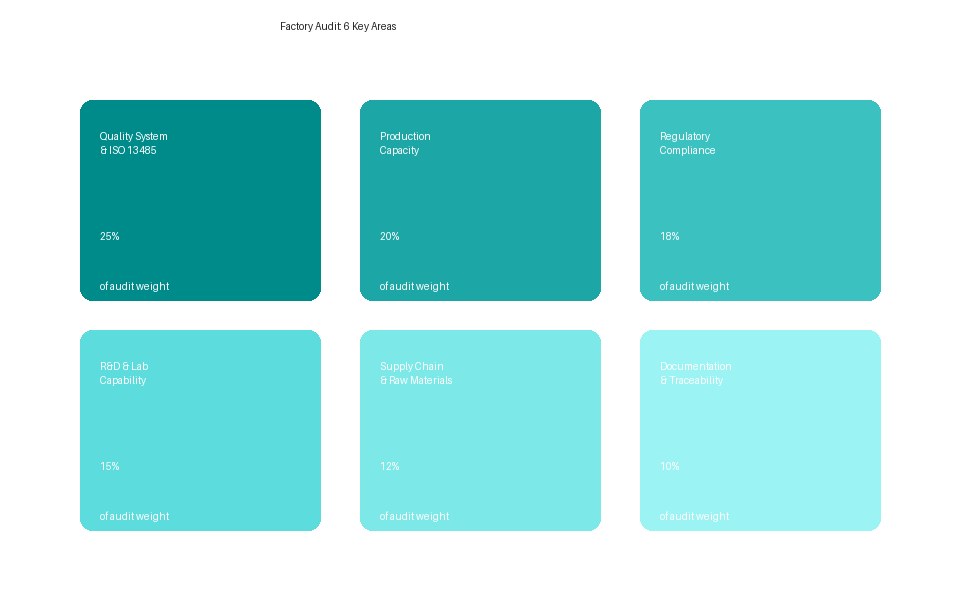
1. Quality System & ISO 13485 (25 points)
Quality management is the foundation. If the factory does not have a functioning QMS, nothing else matters. Weight: 25%.
What to verify:
- Current ISO 13485 certificate from an accredited body (TUV, BSI, SGS, DNV)
- Certificate scope covers medical device manufacturing, not just "general manufacturing"
- Quality manual, standard operating procedures (SOPs), and work instructions accessible and current
- Document control system: are revisions tracked? Are obsolete documents removed from production areas?
- Management review meetings held at least annually with documented minutes
- Internal audit program: scheduled audits, documented findings, corrective actions
- CAPA (Corrective and Preventive Action) system: examples of past CAPAs and their effectiveness
2. Production Capacity & Equipment (20 points)
Can the factory actually deliver your volume? Many smaller factories claim capacity they cannot sustain at peak quality. Weight: 20%.
What to verify:
- Production line count and capacity (patches per day per line)
- Equipment age, maintenance records, and calibration certificates
- Cleanroom classification and certification (ISO 7 or ISO 8 for pain patches)
- Production scheduling system: how orders are prioritized and tracked
- Changeover time between products: faster changeovers enable smaller batch runs
- Yield rates: what percentage of finished product passes QC? Industry benchmark is 96-99%
- Peak season capacity vs. baseline: can they scale up 2-3x for your peak season?
3. Regulatory Compliance (18 points)
For FDA, CE, and other regulated markets, the factory must have regulatory expertise or you risk delays and rejection. Weight: 18%.
What to verify:
- FDA establishment registration (verify in the FDA database)
- FDA Drug Establishment Registration (if products contain API)
- CE technical file capability: have they filed CE technical files for similar products?
- Drug Master File (DMF) access for active ingredients
- Country-specific registrations: TGA (Australia), PMDA (Japan), KFDA (Korea), ANVISA (Brazil), Health Canada
- Labeling compliance expertise: can they prepare labels that meet multi-market requirements?
- Adverse event reporting procedures
4. R&D and Laboratory Capability (15 points)
For OEM and custom formulation work, R&D capability is essential. Without it, you cannot develop or troubleshoot products. Weight: 15%.
What to verify:
- In-house R&D team size and credentials (chemists, formulators, PhDs)
- Pilot lab and formulation development equipment
- Analytical lab: HPLC, GC, dissolution testing, content uniformity
- Stability testing capability (ICH Q1A accelerated, intermediate, long-term)
- Microbiology lab for microbial limits testing
- Sample retention procedures
- Patent and IP protection protocols (especially for OEM customers)
5. Supply Chain and Raw Materials (12 points)
Quality starts with raw materials. If the factory sources cheap ingredients, your finished product will fail QC. Weight: 12%.
What to verify:
- Approved supplier list (ASL) with qualification criteria
- Raw material specifications and Certificates of Analysis (CoA) for each lot
- Incoming material testing procedures
- Active pharmaceutical ingredient (API) sourcing: who manufactures it? Can you audit the API supplier?
- Adhesive matrix sourcing: medical-grade vs. industrial-grade
- Packaging component sourcing: pouch film, printing inks, desiccants
- Supplier audit program: does the factory audit its own suppliers?
- Inventory management: FIFO, expiry date tracking, segregation of rejected materials
6. Documentation and Traceability (10 points)
When something goes wrong, you need to trace the problem back to its source. Complete batch records make this possible. Weight: 10%.
What to verify:
- Batch production records: complete, contemporaneous, signed off at each step
- Lot traceability: can they trace any finished product back to raw material lots?
- Retention samples: kept for the product shelf life plus a safety margin
- Certificate of Analysis (CoA) per batch: issued, signed, and archived
- Certificate of Compliance (CoC) per batch: regulatory and customer-specific requirements documented
- Change control procedures: how are formula, process, or supplier changes managed?
- Deviation management: how are out-of-specification events handled and documented?
- Electronic vs. paper records: if electronic, are systems validated (21 CFR Part 11)?
The 100-Point Audit Scoring System
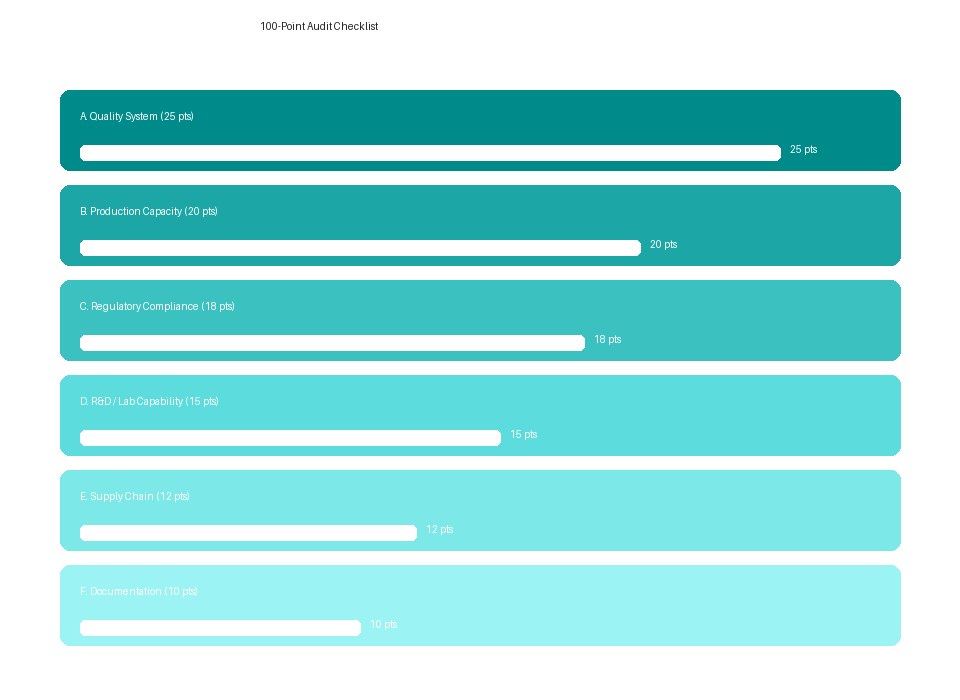
Experienced procurement teams score factory audits on a 100-point scale. The score is not a marketing number; it is a risk assessment that determines whether to proceed, proceed with conditions, or walk away.
Scoring Bands
- 90-100 (Excellent): top-tier manufacturer, suitable for regulated markets and long-term partnerships. Proceed with confidence.
- 80-89 (Good): solid manufacturer with minor gaps. Proceed with a corrective action plan addressing the gaps within 3-6 months.
- 70-79 (Acceptable): meets minimum standards but has notable weaknesses. Proceed only for low-risk applications (wholesale catalog products) and require quarterly check-ins.
- 60-69 (Marginal): significant gaps in critical areas. Not recommended for OEM or regulated market work. Consider for trial orders only with extensive QC on receipt.
- Below 60 (Fail): critical gaps that pose material risk. Walk away regardless of price.
Section A: Quality System (25 points)
Score each item 0-5 based on completeness and effectiveness:
- Current ISO 13485 certificate from accredited body (5 pts)
- Certificate scope covers relevant device classification (5 pts)
- Quality manual accessible and current (3 pts)
- SOPs for critical processes documented and followed (3 pts)
- Document control system functional (3 pts)
- Management review held annually with minutes (2 pts)
- Internal audit program active (2 pts)
- CAPA system with documented examples (2 pts)
Section B: Production Capacity (20 points)
- Production lines adequate for your volume (4 pts)
- Equipment age and maintenance records (3 pts)
- Cleanroom certification (ISO 7 or 8) (4 pts)
- Production scheduling system (3 pts)
- Yield rates meet industry benchmark (96%+) (3 pts)
- Peak season capacity verifiable (3 pts)
Section C: Regulatory Compliance (18 points)
- FDA establishment registration active and verifiable (4 pts)
- CE technical file capability demonstrated (3 pts)
- Drug Master File (DMF) for APIs (3 pts)
- Country-specific registration experience (3 pts)
- Labeling compliance expertise (2 pts)
- Adverse event reporting procedures (3 pts)
Section D: R&D and Lab (15 points)
- In-house R&D team with relevant expertise (3 pts)
- Pilot lab with formulation equipment (3 pts)
- Analytical lab (HPLC, GC, dissolution) (3 pts)
- Stability testing capability (ICH Q1A) (3 pts)
- Microbiology lab (2 pts)
- Sample retention procedures (1 pt)
Section E: Supply Chain (12 points)
- Approved supplier list with qualification (2 pts)
- Raw material CoAs per lot (2 pts)
- Incoming material testing (2 pts)
- API sourcing verifiable (2 pts)
- Medical-grade adhesive matrix (2 pts)
- Supplier audit program (2 pts)
Section F: Documentation (10 points)
- Complete batch production records (2 pts)
- Lot traceability system (2 pts)
- Retention samples (2 pts)
- CoA per batch (1 pt)
- CoC per batch (1 pt)
- Change control procedures (1 pt)
- Deviation management (1 pt)
How to Use the Score
The total score tells you the overall risk level, but the section scores tell you where the specific risks are. A factory with 85 total points but only 8 points in regulatory compliance is very different from a factory with 85 total points but only 8 points in documentation. The first is risky for FDA work; the second is risky for traceability. Always read the section scores, not just the total.
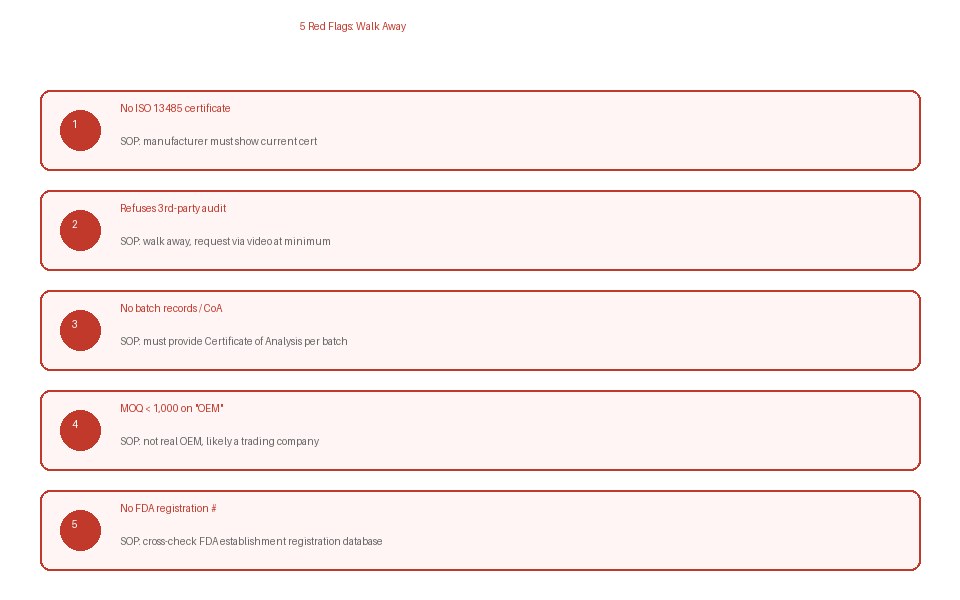
5 Red Flags: When to Walk Away from a Pain Patch Manufacturer
Some issues are deal-breakers. No matter how good the price or how polished the sales pitch, these red flags mean you should walk away immediately.
Red Flag 1: No Current ISO 13485 Certificate
Pain patches are medical devices. ISO 13485 is the baseline quality management standard. A factory without ISO 13485 is operating below industry minimum. Walk away.
Verification: ask to see the certificate, then verify the issuing body's accreditation. The certificate should be from an IAF-accredited certification body (TUV, BSI, SGS, DNV, Bureau Veritas, etc.). Verify the certificate number on the issuing body's website. Some factories display expired or fake certificates.
Red Flag 2: Refuses Third-Party Audits
If a factory refuses third-party audits, video walkthroughs, or even detailed written questionnaires, they are hiding something. Legitimate manufacturers welcome audits as a sales tool. Refusal is a deal-breaker.
Verification: ask if they allow third-party inspectors (SGS, Bureau Veritas, TUV) on-site. If they say no, or only allow their "preferred" inspectors who are actually affiliated with the factory, walk away.
Red Flag 3: No Batch Records or Certificate of Analysis
If the factory cannot show you a completed batch production record and a Certificate of Analysis for a recent production batch, they do not have a functioning quality system. No documentation means no traceability, no accountability, and no recourse when things go wrong.
Verification: ask to see a redacted batch record and CoA from a recent production run. The document should include the batch number, production date, raw material lot numbers, in-process test results, and final product test results. If they cannot produce this, walk away.
Red Flag 4: MOQ Below 1,000 for "OEM"
Real OEM requires formulation work, pilot batches, stability testing, and dedicated production runs. The economics require 20,000+ units minimum. A factory offering 1,000-unit "OEM" is either (a) doing private label on a stock formula and calling it OEM, or (b) a trading company that does not actually manufacture anything.
Verification: ask what changes in the formulation. If they say "we just put your label on it," that is not OEM, that is private label. If the formulation is exactly the same as their catalog product, that is wholesale with a label, not OEM.
Red Flag 5: No FDA Establishment Registration
Any factory that exports pain patches to the United States must have an active FDA establishment registration. This is verifiable in the FDA's public database. A factory that claims to ship to the US but has no registration is breaking the law and putting your import at risk.
Verification: ask for their FDA Establishment Registration (FEI) number. Then check the FDA database at https://www.accessdata.fda.gov/scripts/cder/auditreview/. If the registration does not exist, or the name does not match the factory name, walk away.
Bonus Red Flags
A few more signals that warrant caution:
- Pricing 20%+ below market: either the quality is compromised, or there are hidden costs that will appear later
- Pressure to pay 100% upfront: legitimate manufacturers accept 30-50% deposit with balance on shipment
- No references from existing customers: established manufacturers happily share 3-5 customer references
- Contracts only in Chinese: while the factory is Chinese, contracts should be bilingual with an English version governing
- Factory visit only at a specific address with no advance notice: pre-arranged visits with team preparation are normal; same-day "show up and we'll show you" visits are suspicious
How to Conduct the Audit: A Step-by-Step Process
Whether you audit in person, by video, or via a third party, follow this process for consistent results.
Before the Audit
- Send the 100-point checklist to the factory 1-2 weeks in advance and ask them to prepare documentation
- Request specific documents for review: ISO certificate, FDA registration, sample batch records, sample CoAs, organization chart, facility layout, equipment list, approved supplier list
- Schedule 4-6 hours for the audit, including 1-2 hours for document review, 2-3 hours for facility walkthrough, and 1 hour for closing discussion
- Bring a notebook, camera (with permission), and any specific test equipment you want to use (calipers, pH meter, etc.)
- Plan to arrive unannounced at the production area if possible, to see the actual state vs. the prepared-for-visit state
During the Audit
- Start with documentation: review ISO certificate, quality manual, batch records, CoAs in a conference room before walking the floor
- Walk the production flow: raw material receiving → quarantine → released storage → production → in-process QC → finished goods → QC lab → quarantine → released storage → shipping
- Inspect the cleanroom: check air pressure differentials, particle counts (ask for recent data), gowning procedures, operator hygiene
- Observe actual production: watch 30-60 minutes of a real production run, not a demonstration; note operator adherence to SOPs
- Talk to operators: ask them about their work, training, and what to do if something goes wrong; their answers reveal the real state of quality culture
- Review the QC lab: check equipment calibration records, test method validation, sample retention procedures
- Check the warehouse: look for FIFO compliance, expiry date management, segregation of rejected materials, pest control
After the Audit
- Debrief with the factory on the same day; discuss findings while they are fresh
- Request corrective action plan for any gaps, with timeline and responsible person
- Verify critical findings independently (FDA database, ISO certificate body, references)
- Score the audit using the 100-point system
- Make the go/no-go decision within 1 week, while context is fresh
- Document everything for future reference and re-audit comparison
Audit Frequency
Industry best practice is:
- Initial qualification audit before first order
- Annual comprehensive audit for ongoing relationships
- Surprise visits every 6 months for high-volume or high-risk products
- Special audit after any major change (ownership, facility move, regulatory issue, capacity expansion)
KONGDY Health: Audit-Ready Manufacturing Excellence
KONGDY Health welcomes factory audits from prospective and existing customers. We host 200+ audits per year, with an average audit score of 92/100 from third-party inspectors. Here is what you will see when you audit our facility.
Our Quality System
KONGDY Health holds current ISO 13485:2016 certification from TUV SUD, one of the most rigorous European certification bodies. Our quality manual covers design control, production control, post-market surveillance, and CAPA. We undergo annual surveillance audits and a full re-certification audit every 3 years. Our last three audit scores: 94, 92, 95 (out of 100).
Our Production Capacity
We operate 6 production lines across 12,000 m² of manufacturing space, including a 2,500 m² ISO 7 cleanroom. Equipment includes automated coating machines from Germany, slitting and cutting equipment from Japan, and packaging lines from Italy. Our daily capacity is 500,000+ patches, with peak season scaling to 1,000,000+ patches per day. Our yield rate averages 98.2% across all SKUs.
Our Regulatory Capability
We maintain active FDA Establishment Registration (FEI 3008651274), CE technical files for 23 products under MDR, TGA certificates for Australian distribution, and country-specific registrations in 15+ markets. Our regulatory team has filed 40+ 510(k) submissions for customers and prepared 60+ CE technical files.
Our R&D and Lab
Our R&D team includes 8 formulation chemists (3 with PhDs) and 4 analytical chemists. Our lab is equipped with HPLC, GC, dissolution testers, content uniformity apparatus, ICH stability chambers (accelerated, intermediate, long-term conditions), and a microbiology lab. We have developed 200+ custom formulations for OEM customers.
Our Supply Chain
We source APIs from 4 qualified suppliers (including 2 European pharmaceutical companies for lidocaine and diclofenac). Our adhesive matrix is medical-grade from a German supplier. All incoming materials are tested against incoming specifications; lots failing specifications are rejected and returned to the supplier with documented CAPA.
Audit KONGDY
Prospective customers are welcome to visit our facility in Huizhou, Guangdong, China. We can arrange airport pickup, hotel booking, and a 2-day visit that includes the factory audit plus a tour of our R&D lab, production lines, and QC facility. Video audits are available for customers who cannot travel. Contact our B2B team to schedule an audit.
Final Thoughts: The Audit Is Your Best Investment
A factory audit is not an expense. It is insurance against the most common and most expensive mistakes B2B buyers make. The $2,000-$5,000 cost of a thorough audit is trivial compared to the cost of a failed batch, a regulatory problem, or a brand-damaging recall.
Use the 100-point checklist. Score rigorously. Verify independently. Walk away from red flags. The pain patch industry has many excellent manufacturers and a few bad actors. Your job is to tell the difference before you commit, not after.
Whether you choose KONGDY Health or another qualified manufacturer, the audit framework in this guide will help you make an informed decision. A good manufacturer will welcome your audit process. A great manufacturer will share additional information to help you succeed.
Ready to schedule a factory audit? Contact our B2B team to arrange an in-person or video audit of KONGDY Health's facility. We will share our latest third-party audit report, FDA registration, ISO certificate, and 5 customer references within 24 hours of your inquiry.